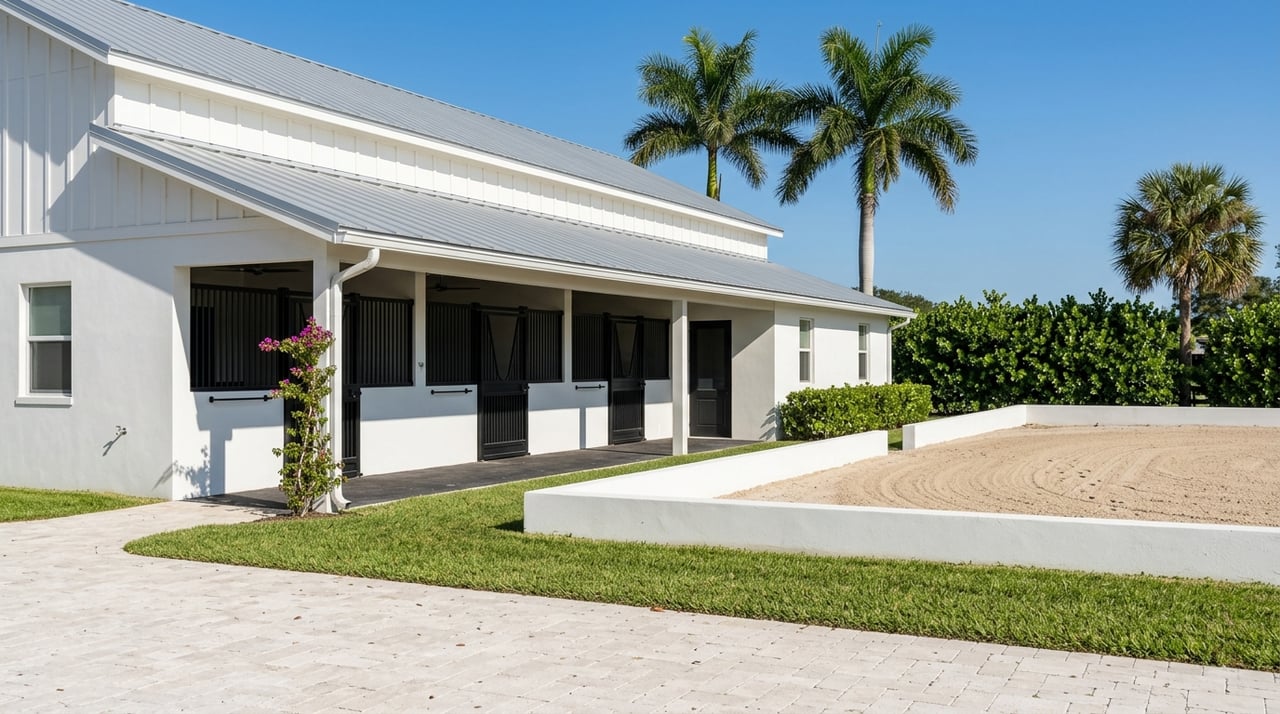
How to Sell Your Wellington Equestrian Home for More
June 4, 2026
June 4, 2026
Are you leaving money on the table by marketing your Wellington equestrian property like a standard luxury home? In this market, buyers are not just evaluating finishes and square footage. They are looking closely at barn function, arena layout, zoning fit, trail access, and location within Wellington’s equestrian ecosystem. If you want to position your property for a premium sale, the details matter. Let’s dive in.
Wellington is not a typical suburban market. The Village identifies the equestrian community as a core part of Wellington’s economy, land use, and identity, with more than 100 miles of public bridle trails and more than 580 farms.
That scale matters when you sell. Buyers looking here often understand equestrian real estate well, so they notice the difference between a beautiful property and a truly functional one. In a market shaped by horse sports, utility and compliance can influence value just as much as presentation.
Wellington International also plays a major role in buyer demand. It describes Wellington as North America’s premier horse sports destination, with the Winter Equestrian Festival and Adequan Global Dressage Festival drawing participants from all 50 states and more than 34 countries.
That global visibility helps explain why premium equestrian listings can attract interest beyond the local buyer pool. For sellers, that means your positioning should speak to both regional and international demand in a clear, polished, and practical way.
In Wellington, location is not just about the street address. It is also about access to the equestrian circuit, especially the showgrounds and Equestrian Village that anchor the winter season.
Wellington International notes that the season includes 13 weeks of WEF and 10 weeks of AGDF. Its venue is about 20 minutes from Palm Beach International Airport, 45 minutes from Fort Lauderdale-Hollywood International Airport, and roughly an hour from Miami International Airport.
For many buyers, especially seasonal and cross-border buyers, that access adds convenience and appeal. A property that offers efficient travel to venues and airports may have stronger marketability than one with similar acreage farther from the action.
Wellington’s bridle trail network is a meaningful local feature. In some cases, the Village may require bridle-trail easements as part of a development order or building permit for a principal equestrian structure or use.
That means trail access and trail-related encumbrances can both matter during a sale. If your property benefits from access, that should be documented and presented clearly. If there are easements or other site-specific conditions, they should be reviewed early so there are no surprises during due diligence.
One of the biggest pricing mistakes sellers make is assuming acreage alone tells the story. In Wellington’s Equestrian Overlay Zoning District, minimum lot sizes and setback standards vary by subarea.
The code shows that minimum lots can range from 1 acre to 10 acres, and principal setbacks vary widely depending on the subarea. That means two properties with similar sizes may not offer the same flexibility, functionality, or buyer appeal.
This is why premium pricing should rely on true equestrian comparables, not generic residential comps. A strong analysis should account for usable acreage, barn placement, ring layout, residence finish level, trail access, and the rules tied to that specific subarea.
In the EOZD, barns, stables, covered arenas, temporary stabling tents, and similar structures are treated as principal uses. That is important because buyers often view these structures as core components of the property, not optional extras.
If fencing is worn, tack areas feel cluttered, or footing looks neglected, buyers may read those issues as signs of deeper functional concerns. In a premium sale, equestrian infrastructure should present as organized, well-maintained, and ready for use.
Wellington’s code also states that dressage walls, sand rings, and riding rings must be set back 10 feet from any property line. Because barns and covered arenas must meet principal-structure setbacks, layout is part of value.
A property with a clean, efficient layout can feel easier to operate and easier to own. A property with improvements that crowd the site or raise compliance questions may face more buyer pushback, even if the home itself shows beautifully.
For an equestrian property, premium presentation is about more than fresh paint and polished photos. Buyers want confidence that the site works well day to day.
The Village’s manure and best-management guidance asks owners to evaluate bare ground, buildings, fences, confinement areas, septic systems, wells, wetlands, ponds, neighboring land uses, runoff, erosion, fertilizer use, and waste management. That guidance offers a useful framework for sellers getting ready to list.
Before your property goes live, it helps to review the full site with a critical eye. You want the farm to look orderly, but you also want buyers to see signs of strong management.
When this work is done before photography and showings, your property is easier for buyers to understand and trust. That can support stronger first impressions and a smoother negotiation process.
Wellington has invested in drainage systems to help prevent flooding in the Equestrian Preserve. Even so, buyers evaluating a premium equestrian property will still pay close attention to drainage performance on the specific site.
If low spots, muddy paddocks, or runoff patterns are visible during showings, those issues can affect how buyers price risk. On the other hand, if the property shows clear organization and sound drainage planning, it can reinforce confidence.
The Village’s equestrian hurricane guidance also supports documenting preparedness and repairs. It advises horse owners to prepare barns and horses in advance, secure movable objects, and inspect the property and take pictures after storm events.
For sellers, that makes practical sense. If you have records of storm-related repairs, mitigation work, or maintenance updates, those materials can help answer buyer questions quickly.
In Wellington, listing timing can be especially important. Based on the Wellington International calendar, the highest concentration of competition and visitor traffic occurs from November through April.
That makes winter and early spring a logical window for many premium equestrian listings. During that period, more buyers, riders, trainers, and decision-makers are already in town and actively engaged with the market.
That does not mean every property should wait for the season. It does mean your timing strategy should consider who the most likely buyer is and when that buyer is most likely to be in Wellington.
Palm Beach County market data provides helpful context, but it should not replace equestrian-specific analysis. In April 2026, the county’s single-family median sale price was $650,000, the median percent of original list price received was 95%, and the median time from listing to contract was 37 days.
At the higher end, sales of properties priced at $3 million and above were up 1.6% year over year. MIAMI REALTORS also reported that 52.2% of closed sales were cash transactions, a sign that many buyers in this market are well-capitalized.
For premium positioning, that matters. You may be negotiating with buyers who are less rate-sensitive and more focused on suitability, convenience, and long-term value.
MIAMI REALTORS’ 2026 first-quarter luxury report placed Palm Beach County’s single-family luxury threshold at $4.4 million and its ultra-luxury threshold at $6.2 million. Those benchmarks are useful for defining the premium segment, but Wellington equestrian estates often need their own comp set.
This kind of pricing is more rigorous, but it is also more credible. In a niche market, credibility is often what protects your value.
A premium equestrian listing deserves more than standard luxury marketing language. The story should explain how the property lives and works.
That means showcasing the relationship between the house, barn, arena, paddocks, access points, and circulation across the site. It also means presenting the property in a way that speaks to serious buyers who understand why layout, efficiency, and Wellington-specific positioning matter.
For sellers in this segment, hands-on preparation and precise marketing can make a measurable difference. The right strategy does not just generate attention. It helps attract the buyers most likely to recognize the full value of your property.
If you are thinking about selling your Wellington equestrian property, a tailored plan matters. From pricing and preparation to polished marketing and targeted exposure, working with an experienced local advisor can help you position your asset with confidence. To start the conversation, connect with Renee Hasak PA.
Stay up to date on the latest real estate trends.

Renee understands that buying or selling a home is one of the biggest decisions in the lives of her clients, and she loves partnering with people to make the process as smooth as possible.